


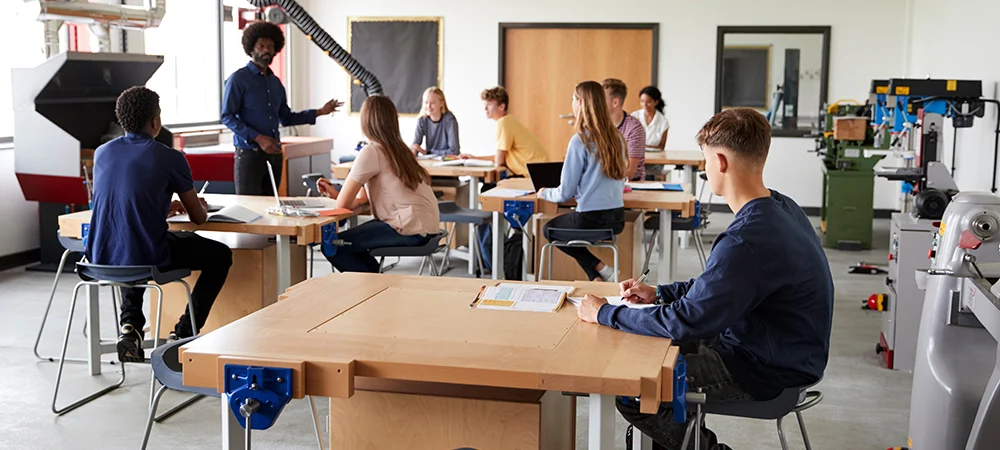

Tony Ryan, Chief Executive Officer at the Design & Technology Association in the UK, did not enjoy school and could not wait to leave. Leading his own school could not have been further from his mind. But that’s what happened. Ryan became a headteacher and now he runs an association which provides support, advice and subject leadership for all those involved in D&T education. In this feature, he talks about how why skill acquisition is just as important as base knowledge.
The title above is borrowed from a book that, as a secondary headteacher, helped to ground me at least once, often twice a year; it’s probably my most-read book (Prof. Guy Claxton, 2008 – Oneworld Oxford). In the opening paragraph of chapter one, Claxton answers his own question: “The purpose of education is to prepare young people for the future.”
As a secondary headteacher, you are running a large and complex organisation. You are managing a budget of over £10 million, a staff of around 90 teachers plus support staff, and together with your governing body, you set the tone and quality of education received by up to 1,500 students. I found that the day-to-day intricacies of the role required me to purposefully step off the treadmill from time-to-time and remind myself of just why I had come into this job in the first place.
My own education was less than perfect. I was bullied mercilessly in my first primary school, so much so that I missed almost a full year’s education due to absence. Secondary school was not much better; it was a brutal place where teachers used the cane for the smallest of transgressions, and fear was the driver for academic performance.
I left as soon as I could, and the thought of one day leading my own school couldn’t have been further from my mind. Once I reached that position, my overriding ambition was to ensure that no student felt as I had. All students get one opportunity at school, as one wise colleague once stated, as we watched students enter the school grounds one morning: “Every one of these students has something to offer, a talent or gift. Some of them will be aware of this, others may need help to find it, our job is to find that talent and let it shine.”
If we are not mindful, at secondary level specifically, school can become all about the examinations in Year 11 (GCSE) and Year 13 (A Level). When asked by a student, “Why am I learning this?” the response, “Because you may be tested on it in an examination”, is an all-too-easy retort. In my experience, that approach will motivate 20% of students at best. In my opinion, the examinations represent a comma, not a full stop. They mark a point on a more expansive journey and not the destination itself.
Schools should teach a combination of knowledge, skills and personal attributes (often incorrectly labelled as ‘soft skills’). Students need a basic level of knowledge within a subject for them to truly make sense of the topic. In design and technology, for example, what is design, and why is it important? What do I know about materials and their properties that will help me to choose appropriately when trying to solve a design problem?
Skill acquisition is as important as that base knowledge; how can I shape this material? Can I utilise CAD and 3D Printing to help develop my initial ideas from sketches into early-stage prototypes that I can pick up, discuss and refine? Finally, what character attributes do I need to build to succeed in this subject? The ability to work alone or in a team, to empathise with someone else’s problem, the tenacity to hit a gnarly problem that challenges you, yet have the strength to find a way around, over or under that initial wall that appeared to stand between you and a solution.
All of this must be accompanied by the creation of a learning environment within which the young person feels safe, comfortable and valued. It is difficult, if not impossible, to be creative when your defences are up and you cannot truly relax and feel secure within a learning environment. We are seeking to cultivate a sense of perpetual curiosity in our young people; they need to feel safe enough to ask why.
At the Design & Technology Association, we have been in existence since 1989, supporting design and technology education in our schools. At the turn of the century, we were the first country in the world to make the study of Design and Technology (D&T) compulsory for all students up until the age of 16, thus recognising how important it would be for young people to be well-versed in an increasingly technologically led world. Where we led, the world followed, and as we diminished the role of design education in our schools in recent years, it flourished in other countries worldwide (and, interestingly, within private education in UK schools).
Our subject moves fast, too fast for teachers delivering the subject in schools to fully keep up with the pace of change. That’s where industry comes in, as so many industries are now offering their time and expertise to UK schools, enabling teachers to more easily make the link between education and business/industry.
At KS3 (11-14-years-old), we have worked closely with industry partners to create authentic design contexts for students across England and Wales to solve. Using LinkedIn as the fantastic communication tool that it can be, we asked industry to present us with real problems that were challenging them now. We then worked with these businesses to contextualise the problem for a younger audience (without watering it down) and to provide video of engineers, designers and other industry professionals talking about how they were tackling the problem, thus showing young people that this was ‘real’ and presenting an insight into career opportunities they otherwise may not know existed. The result is ‘Inspired by Industry’, a suite of learning resources made free to every school in the country via our dedicated website www.inspiredbyindustry.org.uk
Alongside this, we have placed almost 30 teachers in industry settings for three- to five-day placements through our ‘Teachers in Residence’ initiative. Here teachers, giving up time in their holidays, gain a complete 360 degree view of a company, taking back stories and learning that firstly validates their role beyond teaching to the exam, but also adds to their knowledge, experience and confidence, so the next time a student asks, “Sir/Miss, why are we learning this?” The answer will be far better informed and more expansive.
We are building on these initiatives nationally. Industry is increasingly leaning into our work, supporting it financially and with time and expertise; as one business leader put it: “This is not CSR, that’s just the icing on the cake – what we are really doing is seeking to inspire and inform the workforce and consumers of the future.” Reach out if you want to be part of this educational revolution.

