


Manipal Academy of Higher Education (MAHE) Dubai hosted a landmark symposium titled ‘Academic Responsibility in a Fragmented World’. The event, held in partnership with the World Health Summit (WHS) and The Lancet, brought together global health leaders, academia, industry experts and regional stakeholders to deliberate on how academic institutions can serve as catalysts for social good.
MAHE Dubai is the first campus in the GCC region to convene this global academic dialogue in partnership with the World Health Summit. Speaking on why MAHE chose to host this landmark initiative, Lt. Gen. (Dr) M. D. Venkatesh, Vice Chancellor of MAHE, said: “The theme, academic responsibility in a fragmented world, resonates deeply with our founding vision. Manipal Academy of Higher Education came into existence because of societal needs. Late Dr T.M.A. Pai, almost 70–80 years ago, emphasised empowering society with quality education, healthcare, economic empowerment and gender equity. We are not a university now looking to deliver on societal needs; we were established on that very foundation, to make society a better place to live in.”
As part of its continued commitment to public health education, MAHE Dubai has announced plans to launch a new four-year Bachelor of Public Health programme starting in the academic year 2026–2027. The programme aims to address the growing need for trained public health professionals in the region and equip graduates with a comprehensive understanding of the social, environmental and systemic factors that shape health outcomes.
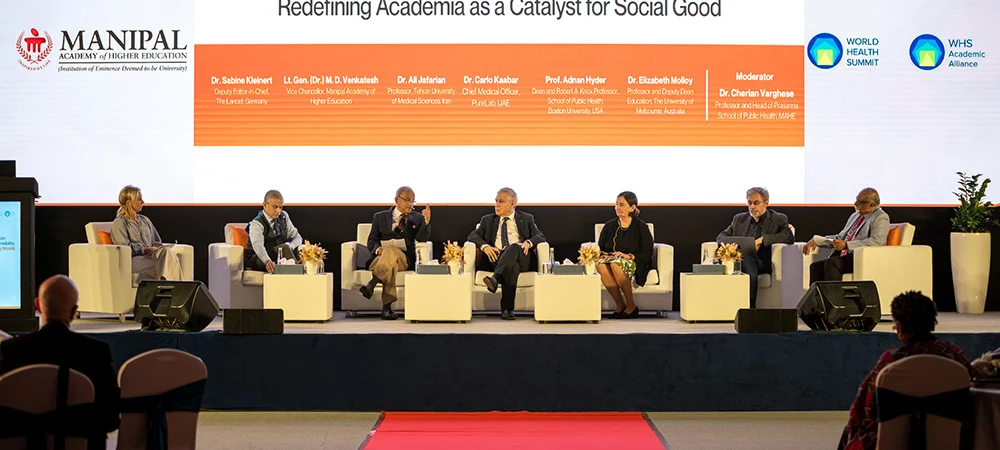
The symposium featured two keynote addresses followed by a panel discussion titled ‘Beyond the Degree: Redefining Academia as a Catalyst for Social Good’. The discussion explored how academic institutions can move beyond traditional research to create tangible social impact, the importance of translating knowledge into policy and community action and the need for greater collaboration between academia, government and the private sector.
The panel was moderated by Dr Cherian Varghese, Professor and Head of Prasanna School of Public Health, MAHE India and featured distinguished voices including Dr Sabine Kleinert, Deputy Editor-in-Chief, The Lancet; Lt. Gen. (Dr) M. D. Venkatesh, Vice Chancellor, Manipal Academy of Higher Education, India; Professor Adnan Hyder, Dean and Robert A. Knox Professor, School of Public Health, Boston University, USA; Dr Elizabeth Molloy, Professor and Deputy Dean (Education), The University of Melbourne, Australia; Dr Ali Jafarian, Professor, Tehran University of Medical Sciences, Iran and Dr Carlo Kaabar, Chief Medical Officer, PureLab, UAE.
Highlighting the importance of collaboration and public engagement, Dr Axel R. Pries, President of the World Health Summit, said: “Academic responsibility requires a continuous exchange with society. Research agendas must be informed by societal needs and scientific outcomes must be communicated in ways that encourage dialogue and trust. Lasting impact can only be achieved through close collaboration across academia, industry, policy and civil society, a core principle of both the World Health Summit and the WHS Academic Alliance in strengthening the role of academia in addressing global health challenges.”
Emphasising the responsibility universities bear towards the communities they serve, Professor Adnan Hyder, Dean of the School of Public Health at Boston University, said: “Academic institutions must first have a philosophical understanding that they owe something to the society in which they exist. Society allows universities to flourish. But it cannot end with the production of knowledge. That knowledge must be integrated into the lives of people – through policies, regulations or the way communities live. And we must also recognise that knowledge is not only produced in academic centres; it is produced in communities too and that knowledge must be valued and used.”

